


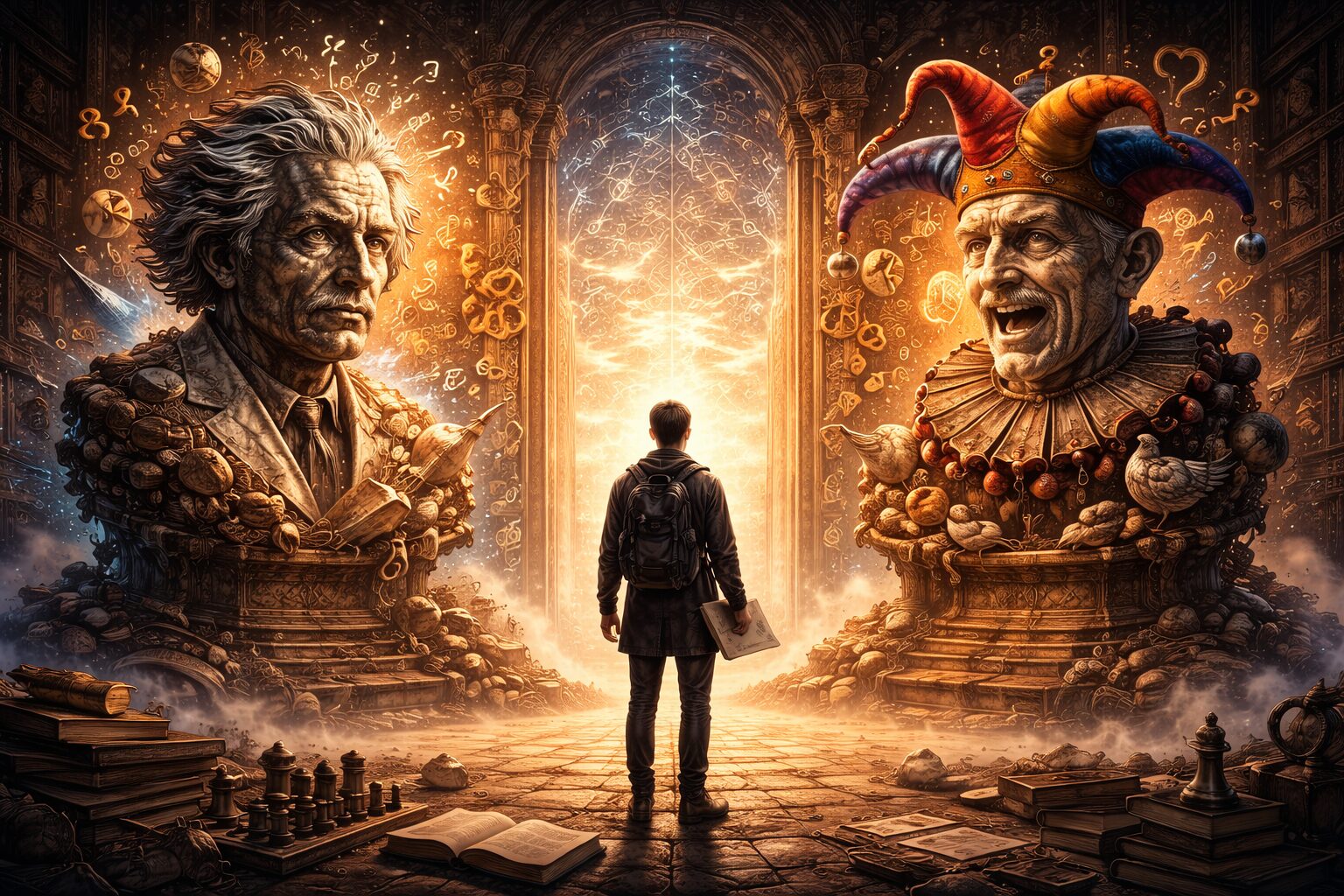
Human beings classify in order to understand.
This is a fundamental function of intelligence—and also its limit.
The claim that “fools are classifiable, while geniuses are not” may sound like a provocative exaggeration. But at its core, it points to a deeper question: how far human cognition can go, and where it begins to break down.
First, why are “fools” classifiable?
Because foolishness tends to become patterned.
If you look at history, errors in judgment show a striking level of repetition. Overconfidence, fixation on short-term gains, denial of inconvenient truths, blind conformity to group thinking—these recur across cultures and eras.
From the political chaos of ancient Rome to modern wars and financial bubbles, human beings repeat the same mistakes. What dominates here is not individuality, but structure.
Take, for example, decisions driven by excessive confidence. They have led countless leaders to ruin. Napoleon’s invasion of Russia, or Hitler’s eastern campaign, are classic cases. Were they unintelligent? Hardly. But structurally, they fell into the same failure patterns.
In this sense, a “fool” is not defined by low intelligence, but by flawed structure.
And structures can be classified.
Now, why are geniuses difficult to classify?
Because they operate outside existing frameworks.
A genius is not simply someone with high ability. A genius is someone who rewrites the framework itself. And because of that, they resist placement within existing categories.
Newton was a physicist, but also an alchemist and a theologian. Einstein revolutionized physics, yet relied heavily on intuition and imagination. Leonardo da Vinci was an artist, a scientist, an engineer—none of these labels fully contain him.
They did not merely fit into categories. They expanded or broke them.
This is the decisive difference.
Foolishness is a malfunction within a framework.
Genius is an intervention upon the framework itself.
That is why the former can be classified, while the latter resists classification.
But this is not merely a discussion of intellectual hierarchy.
The more important question is: which structural tendency do we ourselves embody?
Modern society depends on classification more than ever. Algorithms sort people into categories, evaluate them through attributes, and predict behavior. Education, too, relies heavily on evaluation and categorization.
This system is efficient—but it also produces people who are easy to classify.
In other words, it systematically reproduces “average foolishness.”
Here, foolishness does not mean lack of knowledge. Quite the opposite. It refers to the inability to think outside existing frameworks. Even with vast information, if one’s mode of thinking is patterned, one’s behavior becomes predictable.
And what is predictable is classifiable.
And what is classifiable is controllable.
So what does it mean to be “genius-like”?
It is not simply to be unclassifiable.
More precisely, it is the ability to create new frameworks of classification.
Newton reclassified nature through mathematics.
Da Vinci redefined the boundary between art and science.
Einstein reconstructed the concepts of time and space.
They did not just understand the world. They restructured it.
And this capacity cannot be reduced to innate talent alone. What matters more is one’s distance from existing structures.
Those who fully adapt to existing frameworks may be efficient, but not creative. Those who reject frameworks entirely become mere outliers.
Genius exists between these extremes.
It understands structure, yet is not constrained by it.
To reach this position requires a certain kind of instability.
To step outside classification is to risk losing social recognition and understanding, at least temporarily. Da Vinci and Van Gogh were not fully appreciated in their lifetimes.
What cannot be classified is often not understood.
But at the same time, it is precisely there that the new is born.
From this perspective, the difference between fool and genius is not a fixed trait. It is a matter of positioning within thought.
Anyone who unconsciously conforms to existing structures becomes classifiable.
Anyone who understands, relativizes, and attempts to reconstruct those structures moves toward the unclassifiable.
The real issue is not which side one belongs to, but how conscious one is.
We cannot completely reject classification. We live through language, concepts, and social systems. We inevitably depend on frameworks.
But we do not have to absolutize them.
That is the decisive turning point.
In the end, the statement “fools are classifiable, geniuses are not” is not meant to judge others.
It is a question directed at oneself.
Are you thinking within predefined patterns?
Or are you questioning and reshaping those patterns themselves?
As long as one continues to confront this question, one never fully collapses into the classifiable.
And perhaps a genius is not someone who cannot be classified,
but someone who continues to question the very act of classification itself.
コメント