


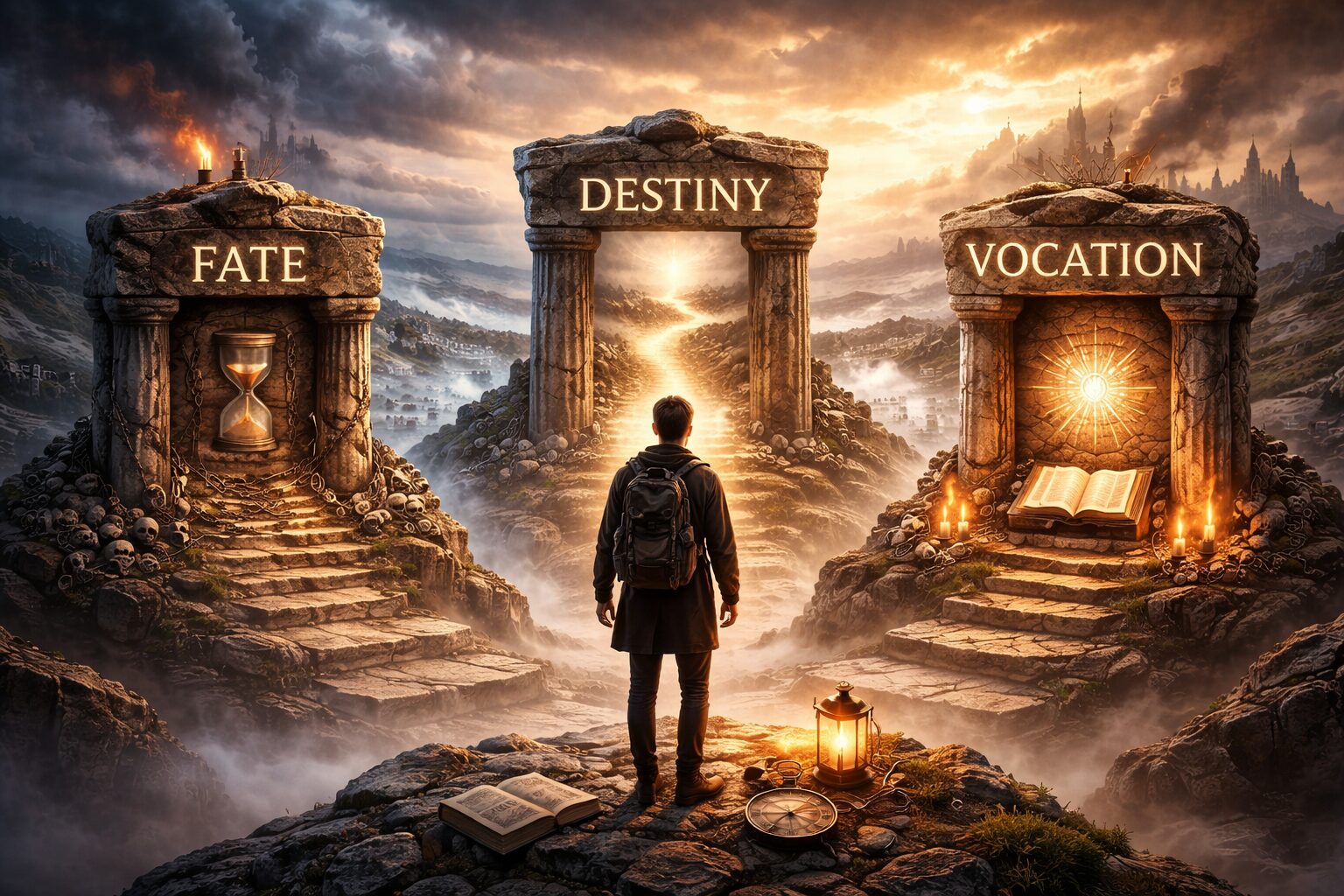
The world is no longer drifting quietly into instability. It is moving there visibly, almost deliberately. Conflicts are no longer isolated; they connect, expand, and accumulate tension that could fracture at any moment. Relations between nations are no longer driven solely by ideology or economics, but by fear and distrust. In such a time, the question of how to live is no longer philosophical in the abstract. It becomes existential.
To think clearly about this, it helps to distinguish three ideas: fate, destiny, and vocation.
Fate is what cannot be changed. The era you are born into, the country, your body, your starting conditions—these are not chosen. They are the initial parameters of the game. You don’t get to reset them.
But fate does not determine everything.
Destiny is what emerges from choice. Within the constraints of fate, how you act, what you pursue, what you refuse—these accumulate. Destiny is not fixed. It is continuously rewritten through decisions.
Vocation is something different. It is not a job title or social role. It is the recognition of what you are for. Not assigned from outside, but discovered from within, usually through friction, failure, and time.
Once you see these three layers, the question of how to live becomes harder—and clearer. Should you be strong? Wise? Loving?
The answer is yes, but not in isolation.
Be strong, but do not depend on strength.
Be wise, but do not become intoxicated by wisdom.
Hold love, but do not drown in it.
And above all, build your own structure.
This is not moral advice. It is a survival strategy.
In The Republic, Plato describes the human soul as having three parts: reason (logos), spirit (thumos), and appetite (epithumia). Justice, he argues, is not about rules imposed from outside, but about internal order—when each part fulfills its proper role in harmony.
This model maps cleanly onto modern life. Reason corresponds to wisdom. Spirit to strength. Appetite, and our relational drives, to love.
The failure mode is always the same: one part takes over.
If strength dominates, it turns into domination. You begin to control others, or become addicted to power. Eventually, you are ruled by fear.
If wisdom dominates, it detaches from reality. You become analytical but inert—trapped in abstraction, drifting toward cynicism.
If love dominates, it dissolves boundaries. You lose yourself in others, unable to distinguish care from surrender.
This is why structure matters.
Structure is internal order. It means having a “state” within yourself.
Plato’s deeper point was not about designing a perfect society, but about governance of the self. A just person is one whose reason leads, whose spirit supports, and whose desires are disciplined—not suppressed, but placed correctly.
Without this internal structure, people are easily shaped by external forces. They react rather than act. They are pulled by outrage, fear, and noise. Much of the polarization we see today is not ideological at its core—it is structural. People without inner order cannot sustain outer stability.
So where should we go from here?
Not toward strength alone. Not toward wisdom alone. Not toward love alone.
The direction is integration.
Accept your fate. Act to shape your destiny. And through that process, discover your vocation.
The world will not stabilize anytime soon. Conflicts will persist. Economies will shift. Values will fragment. If you are waiting for external order before you build internal order, you will be waiting indefinitely.
So reverse it.
Be strong. But do not rely on it.
Be wise. But do not hide in it.
Hold love. But do not dissolve into it.
And build a structure within yourself that can hold all three.
That is not idealism. It is the only durable strategy left.
In a chaotic age, the last place order can reliably exist is within the individual.


コメント