


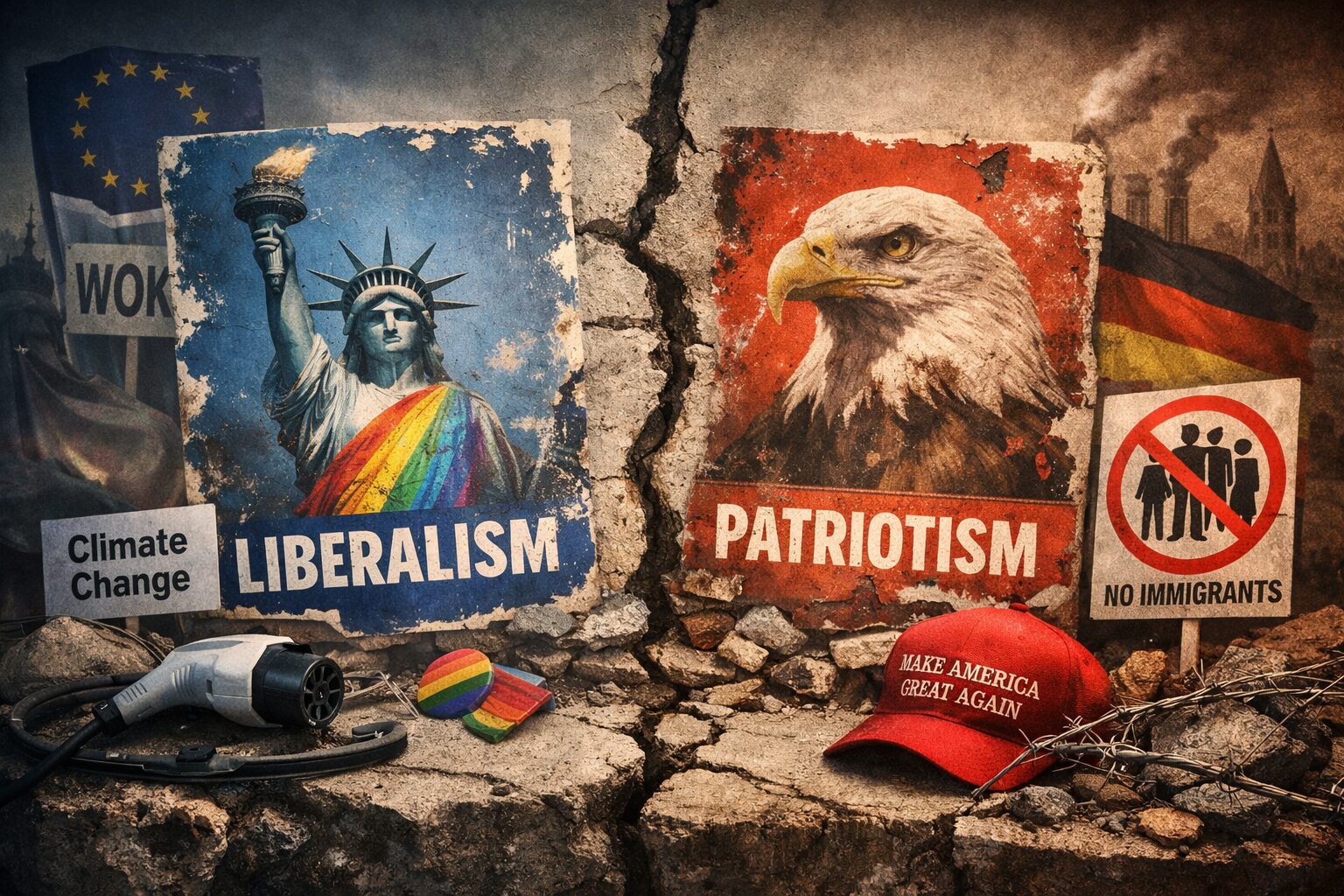
When we step back and examine contemporary international politics, it becomes clear that liberalism has moved beyond mere electoral setbacks into something more serious: a loss of public trust, and increasingly, a loss of dignity. In many places, it is no longer simply opposed—it is mocked.
The resurgence of Trumpism in the United States, the rise of right-wing parties in Germany, the consolidation of conservative leadership in Italy, and the persistent weakness of liberal opposition forces in Japan are not isolated phenomena. They are signals of a deeper structural problem within liberalism itself.
To understand what is happening, we need to ask a more precise question. Not “Why is liberalism losing?” but “Why has it become something people laugh at?”
The Problem with Being “Right”
For a long time, liberalism occupied what it considered the moral high ground. It stood for human rights, diversity, environmental protection, and international cooperation. These are not trivial achievements. But something subtle went wrong in how liberalism handled its own sense of correctness.
At some point, being right stopped being the starting point of discussion and became the end of it.
Instead of saying, “This is what we believe—let’s test it against reality,” liberal discourse increasingly implied, “This is already settled. Disagreement is a sign of ignorance or prejudice.”
If we borrow Paul Graham’s framework on disagreement, this is a crucial mistake. The strongest form of argument engages with the core of the opposing view. But much of liberal discourse settled into something weaker: identifying moral or factual flaws in opponents without engaging their underlying experiences.
People are rarely persuaded by being told they are wrong. They are even less persuaded when they feel looked down upon.
And that is what began to accumulate—not just disagreement, but a sense of humiliation.
The Shift from Workers to Winners
Another turning point came with globalization.
Historically, liberalism positioned itself as an advocate for workers and economic fairness. But over time, it became more closely aligned with those who benefited from globalization: highly educated, urban, mobile professionals.
Its priorities shifted accordingly. Issues such as climate change, gender equality, and minority rights became central. Again, these are important. The problem was not their inclusion, but their dominance over more immediate concerns.
For many people, daily life is shaped by wages, job stability, housing costs, and public safety. When political discourse appears to prioritize symbolic or long-term issues over immediate material concerns, it creates a perception gap.
Policies that make sense in theory can feel indifferent in practice. Encouraging energy transitions without addressing rising costs, or advocating immigration without acknowledging local strain, can make liberalism seem detached from reality.
At that point, it no longer feels like representation. It feels like instruction.
What Liberalism Failed to Do
The decline of liberalism is not just about mistakes. It is also about omissions.
First, it failed to adequately manage the downsides of globalization. As industries declined and communities weakened, there were not enough effective systems for redistribution, retraining, or regional recovery.
Second, it avoided the hard design problems of immigration. Supporting openness in principle is easy; managing integration, infrastructure, and social cohesion is not. Liberalism often stayed at the level of principle.
Third, it lost the ability to admit error. When policies produced unintended consequences, the response was often defensive rather than adaptive. Critics were framed as morally suspect instead of being treated as sources of feedback.
This pattern erodes trust quickly. People do not expect perfection from governments. But they do expect responsiveness.
The New Shape of Conservatism
The rise of modern conservatism is not simply a return to tradition. In many ways, it is a reaction to liberalism’s evolution.
Traditional conservatism tended to be institutional, cautious, and elite-driven. Today’s conservatism is more populist, more emotional, and explicitly anti-elite.
It draws strength from a simple but powerful claim: “You have been ignored.”
In doing so, it has taken over a role liberalism once played—that of representing ordinary people against distant power structures.
This does not necessarily make its policies better. But it makes its message more resonant.
People are not only choosing policies. They are choosing who seems to understand them.
Why Anti-Immigrant Sentiment Gains Traction
The rise of anti-immigrant sentiment, especially in Europe, is often framed purely as xenophobia. That is incomplete.
It is also about perceived pressure on jobs, welfare systems, and cultural continuity. These concerns may be overstated in some cases, but they are not imaginary.
When expressing such concerns leads immediately to moral condemnation, discussion shuts down. But the underlying anxiety does not disappear.
It goes elsewhere—often toward movements willing to articulate it more aggressively.
Modern conservative actors have been effective not because they created these concerns, but because they gave them a voice.
What Would It Take for Liberalism to Recover?
A revival of liberalism is possible, but not without change.
First, it needs to reconnect ideals with outcomes. Abstract commitments must translate into visible improvements in people’s lives. For example, environmental policy must be paired with cost reduction, not just long-term goals.
Second, it must change how it communicates. This means moving away from technocratic language and moral framing toward explanations grounded in everyday experience.
Third, it must restore dialogue. Disagreement should not trigger exclusion. It should trigger investigation. Why do people think what they think? What conditions produced that view?
Ridicule thrives where dialogue disappears.
Finally, liberalism needs to regain humility. Not as a rhetorical gesture, but as an operating principle. The assumption of being inherently correct is precisely what made it fragile.
Conclusion
Liberalism did not become an object of ridicule simply because it lost elections. It became one because it stopped engaging with reality in a way people could recognize, and stopped treating disagreement as something worth understanding.
At the same time, the rise of modern conservatism—especially in its more exclusionary forms—carries its own risks, including division and instability.
What is needed now is not a simple shift from left to right, but the reconstruction of a form of liberalism that is both principled and grounded. A liberalism that connects ideas to lived experience.
In the end, the path back is not through asserting correctness, but through rebuilding trust.
And trust begins with the willingness to understand.


コメント