


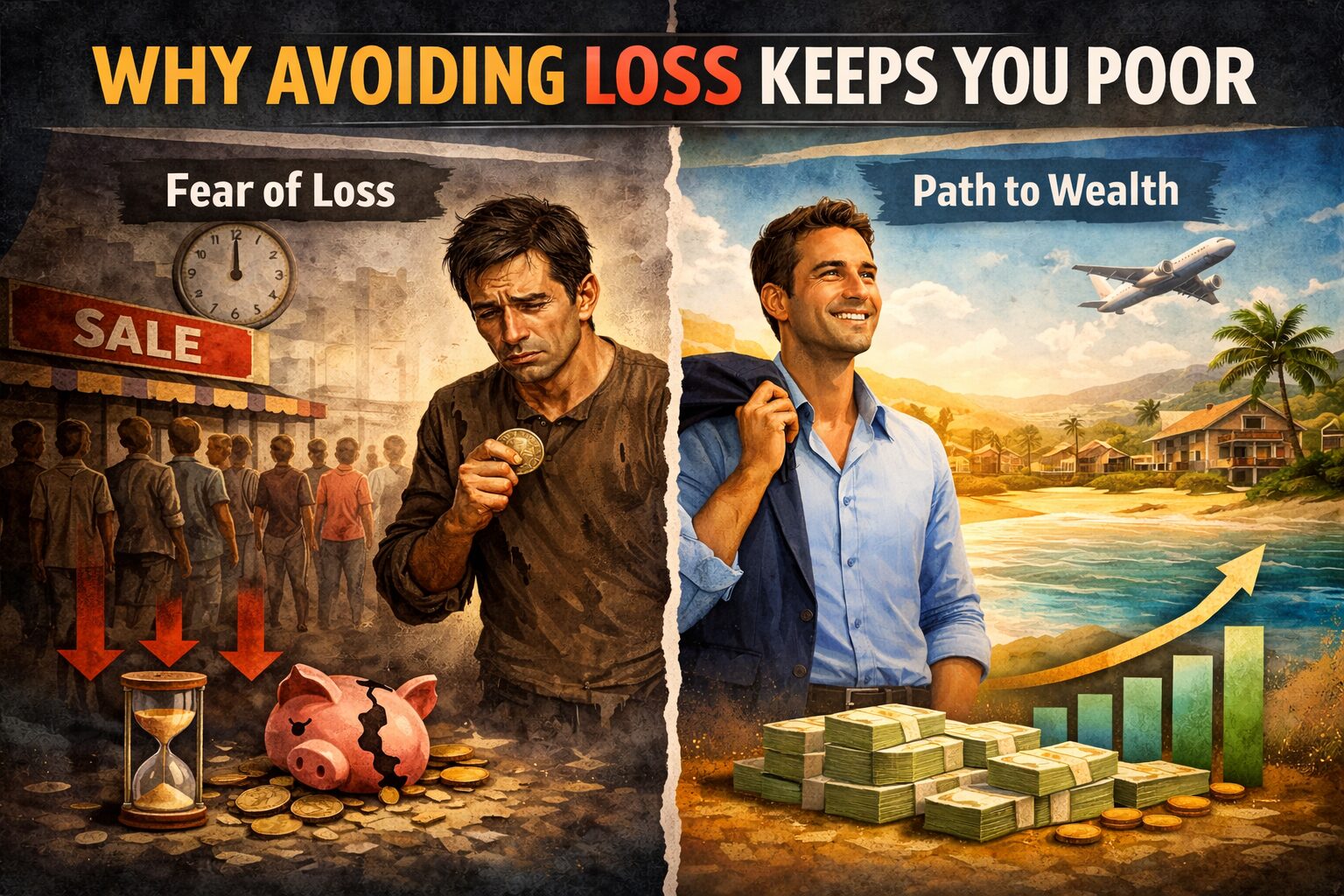
1. People Who Obsess Over “1 Yen” While Throwing Away “1 Hour”
Some people ride their bicycles for 30 minutes to a store in the next town just to save a few dozen yen during a supermarket sale. Others spend hours standing in line for a free promotional giveaway.
At first glance, this may seem like smart, frugal behavior. But there is a dangerous trap hidden here.
Their standard is always: “I don’t want to lose money.”
Yet they fail to realize that this very obsession is costing them their most valuable asset—time—and, perhaps more importantly, their peace of mind.
2. The True Nature of the “Scarcity Mindset”: Fear of Losing
Through my work, I’ve noticed a common trait among people who never become wealthy:
their focus is not on gratitude or respect toward others, but on the fear of losing money.
- They insist on splitting bills down to the last yen at social gatherings.
- They complain that services are “too expensive,” even after receiving them.
- They cannot genuinely celebrate others’ success and may even try to pull others down.
- They quickly complain to the government about when the next subsidy will come.
All of these behaviors stem from a deep sense of lack.
Because they constantly feel “I don’t have enough” or “something will be taken from me,” they carry a gloomy expression and emit a kind of negative energy that pushes people away.
3. What Index Investing Taught Me: The Courage to Let Go
I have been practicing index investing for the past 20 years.
Investing, by nature, means exposing your current cash to risk and temporarily letting it go.
If I had clung to the mindset of “not wanting to lose even a single yen,”
there is no way I could have built my current assets of 100 million yen.
Even when markets crash and assets temporarily shrink,
you must believe in long-term growth and wait.
This is only possible when you have a long-term perspective that goes beyond short-term gains and losses.
The truth is, the obsession with “avoiding loss” is the same as rejecting the benefits of compound growth—the very source of large returns.
4. The Source of Wealth Lies in Reciprocity
Imagine your ideal retirement:
traveling with your spouse, freely giving gifts to your grandchildren without hesitation.
What exists there is not the fear of losing—but the joy of giving.
You provide value to society and others, receive money as a form of gratitude,
and then circulate that money back into society while enriching yourself in the process.
This cycle of reciprocity is the true engine of wealth creation.
Those who only think about taking (takers) may seem to gain in the short term,
but in the long run, they lose trust and drift toward a lonely future.
5. A “Mental Declutter” You Can Start Today
So how can you break free from this mindset?
Start with something simple in your daily life:
express gratitude in words.
- Say “thank you” to the cashier at a convenience store.
- Pay for services based not on “cheapness,” but on value.
Even this small shift will begin to rewire your brain:
from “I am someone who is being deprived” to
“I am someone who has enough to give.”
Conclusion: A 100 Million Yen Fortune Is Built by Not Clinging to 1 Yen
When you let go of the obsession with avoiding loss,
something interesting happens—money and opportunities begin to flow.
Philosophically speaking, only by releasing attachment can you become truly free.
Free to travel whenever you wish.
Free to do what you want, when you want.
The version of you that deserves that future is not someone who reacts emotionally to small gains and losses,
but someone who carries a calm, confident smile.
Next time, I’ll talk about how to transform your life through appearance:
“Cleanliness as the Ultimate Investment.”

コメント